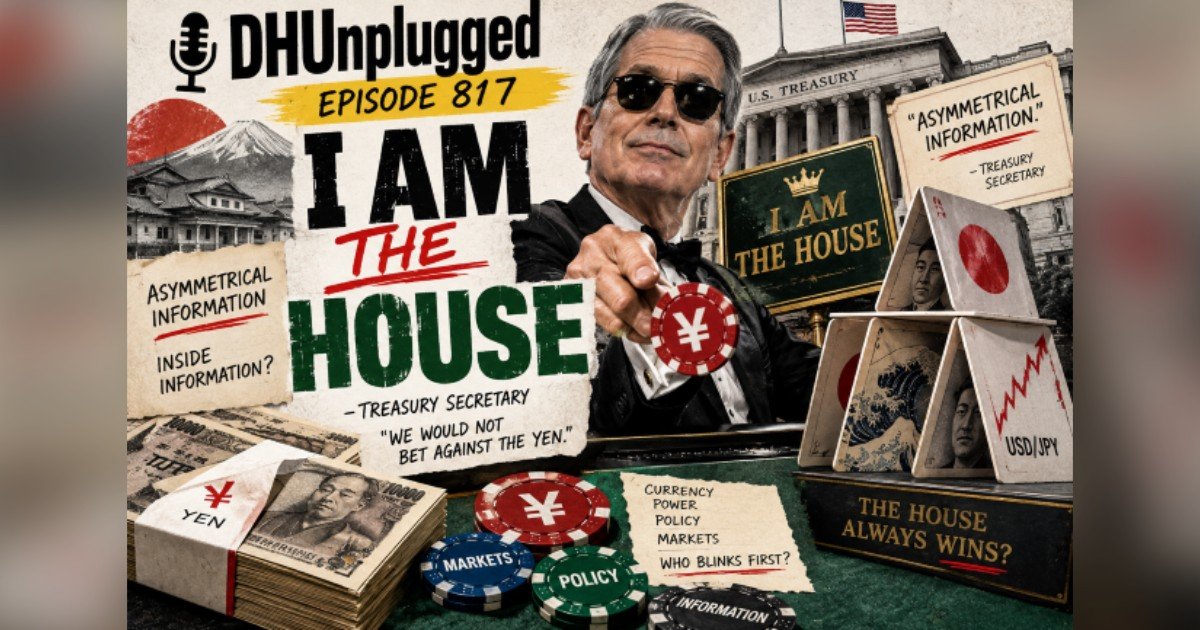
The latest episode of DH Unplugged, titled "I Am The House," arrives as markets are rattled by a post-Labor Day selloff, with the Dow down more than 600 points. The hosts, Andrew Horowitz and JC Dvorak, focus on Treasury Secretary Bessent's provocative statement that he holds inside information on the Japanese yen, framing it as a watershed admission that policymakers now play the market as "the house." This comes ahead of a CPI print on Friday that many strategists are calling the ultimate credibility test for the Federal Reserve.
Bessent's comment, as recounted by Horowitz, was blunt: "I have the inside information about what Japan is doing, therefore when I say something, it's not going to be speculative. It's going to be absolute." Dvorak places this in historical context, arguing that since 2008, the government has increasingly behaved like the Roman Senate before Caesar, and the Trump era has made this dynamic impossible to ignore. The hosts also explore the "dollar milkshake" conspiracy theory circulating online, which suggests that the dollar's strength is intentionally orchestrated to suck in global liquidity.
Beyond Bessent, the episode covers a range of consequential stories. A dead-quiet Strait of Hormuz on AIS trackers is juxtaposed with Goldman Sachs' $120 per barrel oil target, hinting at potential supply disruptions. Rising 10-year and 30-year Treasury yields are examined against a $40 trillion debt backdrop, with Horowitz explaining that his firm is buying only short-duration Treasuries due to the crush of new issuance from Washington and data center operators tapping capital markets globally.
The conversation also touches on Meta's roughly $18 billion multi-state settlement over youth safety guardrails, NVIDIA's reported $13 billion acquisition of Hugging Face—which JC called a week early—and the addition of Bloom Energy to the S&P 500, which triggered sympathy rallies in Oklo and SMR. Strength in Intel, AMD, and SK Hynix is noted ahead of Broadcom earnings. Other threads include Shein's downsized Hong Kong IPO, Good Good Golf's Callaway ad backlash, Nike's exit from the S&P 500, Argentina beef imports, a 162,000 payrolls print, and Astra's partial Navier-Stokes proof.
The hosts' skeptical, unfiltered tone is on full display as they connect these dots, arguing that the bond market's behavior reflects deeper structural issues, not just transient inflation. They question whether the Fed can maintain credibility when fiscal policy and market intervention blur the lines between monetary and political objectives. The episode underscores a growing unease that policymakers are no longer neutral referees but active participants, a shift with profound implications for investors and the broader economy.