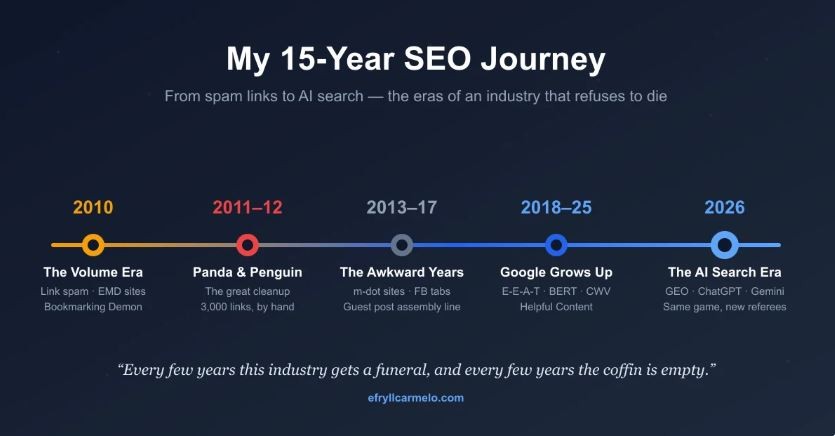
Senior SEO manager Efryll Carmelo has published a retrospective on his 15-year career in search engine optimization, documenting the industry's transformation from automated link-building software in 2010 to the rise of AI-generated search results in 2026. The article, titled 'My 15-Year SEO Journey: From Spam Links to AI Search,' traces key algorithm updates and argues that AI search represents a new chapter rather than the end of SEO.
Carmelo, who has worked with clients in the United States, Canada, and Australia since 2010, recalls the early days when rankings relied on volume. Automated tools like Bookmarking Demon submitted sites to hundreds of directories overnight, while Market Samurai surfaced low-competition keywords. 'My first job in this industry was link builder, and the job was exactly what it sounds like,' said Carmelo. He built micro-niche websites on exact-match domains with thin content, each earning $20 to $50 a month, a system that felt like a 'machine that would run forever.'
That machine stopped with Google's Panda and Penguin updates in 2011 and 2012, which targeted thin content and manipulative links. Carmelo notes that the disavow tool did not yet exist, forcing manual cleanup of thousands of backlinks. 'Entire businesses disappeared from search results overnight,' he said. 'That was the industry's first hard lesson: whatever shortcut works today is the liability you will be dismantling tomorrow.'
The article also covers the transition from separate mobile sites to responsive design, the rise of guest posting, and Google's Helpful Content updates that rewarded people-first writing. Looking to the present, Carmelo highlights that AI Overviews now appear in 25% of Google searches, while 58.5% of U.S. searches end without a click. However, AI-driven referral traffic to retail sites converted 31% better during the 2025 holiday season. Carmelo argues that traditional optimization is expanding into generative engine optimization, the practice of earning citations in AI-generated answers.
'Every few years this industry gets a funeral, and every few years the coffin is empty,' Carmelo said. 'As long as there is a search box, there is an engine behind it, and there will be people whose job is to understand how that engine decides.' He encourages newcomers to embrace the shift, noting that no one has 15 years of experience in AI search because the field is only a few years old. 'You survive on patience, because results are earned in months rather than days, and on a genuine love for the game, because the game refuses to stay the same.'