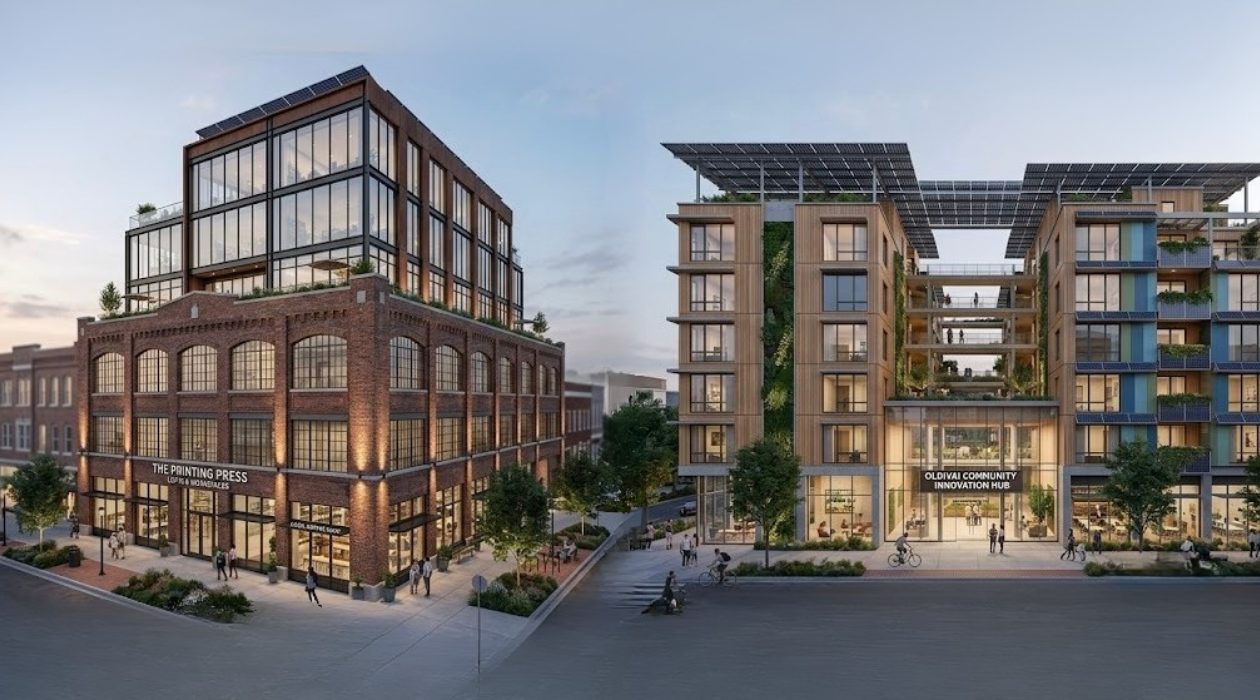
Kaufman Real Estate & Consulting and development partner Oldivai have unveiled plans for a two-site redevelopment in Jacksonville's Springfield Historic District, aiming to blend historic preservation with new workforce housing. The project encompasses the adaptive reuse of a century-old brick industrial building at the northwest corner of Main and 12th streets, paired with a modular workforce housing community across West 12th Street.
The two-story brick building, formerly home to Screen Process Printers Inc., was acquired in October 2019 by Springfield Community Development LLC, an entity managed by Daniel Kaufman, along with a companion 0.23-acre vacant commercial parcel at 2124 N. Main St. The combined purchase totaled $515,000. The site sits in the Springfield Warehouse District, adjacent to Andrew A. Robinson Elementary School, within one of the largest historic districts in the southeastern United States.
The redevelopment plan preserves the building's original brick shell and adds three new stories on top, totaling five stories. The project will include ground-floor retail and workspace, rooftop terraces, 80 residential loft units, and 50 workspace suites, bringing life to a corner that has been dormant for decades. This approach reflects Kaufman Real Estate & Consulting's broader adaptive-reuse philosophy: pairing historic character with new supply rather than choosing between preservation and growth.
On the companion parcel across West 12th Street, Oldivai will develop a new workforce housing community using an iteration of its Project Zero model. This modular, kit-of-parts construction methodology involves building modules off-site in a climate-controlled factory using LEAN/Six Sigma manufacturing methods, then delivering and setting them in place by crane. This accelerates the development timeline and improves quality and cost control relative to conventional construction. The community will target the “missing middle” — teachers, healthcare workers, first responders, and tradespeople earning approximately 80–120% of area median income.
Daniel Kaufman, President of Kaufman Real Estate & Consulting, emphasized the significance of the project: “Springfield is one of the best examples in the country of what adaptive reuse can do for a neighborhood. We’ve owned this corner since 2019 because we believed it deserved a plan that respected its history instead of erasing it. Restoring the building and building workforce housing across the street lets us do both at once.”
Susan Gillespie, Chief Operating Officer of Oldivai, highlighted the modular approach: “Project Zero proved that modular construction can deliver workforce housing faster and at higher quality than the conventional process allows. Jacksonville gives us the chance to bring that model to a neighborhood with real employment density and real need for attainable housing.”
The adaptive-reuse portion involves an estimated $40 million investment and a 24- to 30-month delivery timeline. The workforce housing component, with 150 units across a six- to seven-story massing, is estimated at $35 million and a 16- to 20-month delivery timeline. The projects are expected to contribute significantly to the area's housing supply and economic vitality.