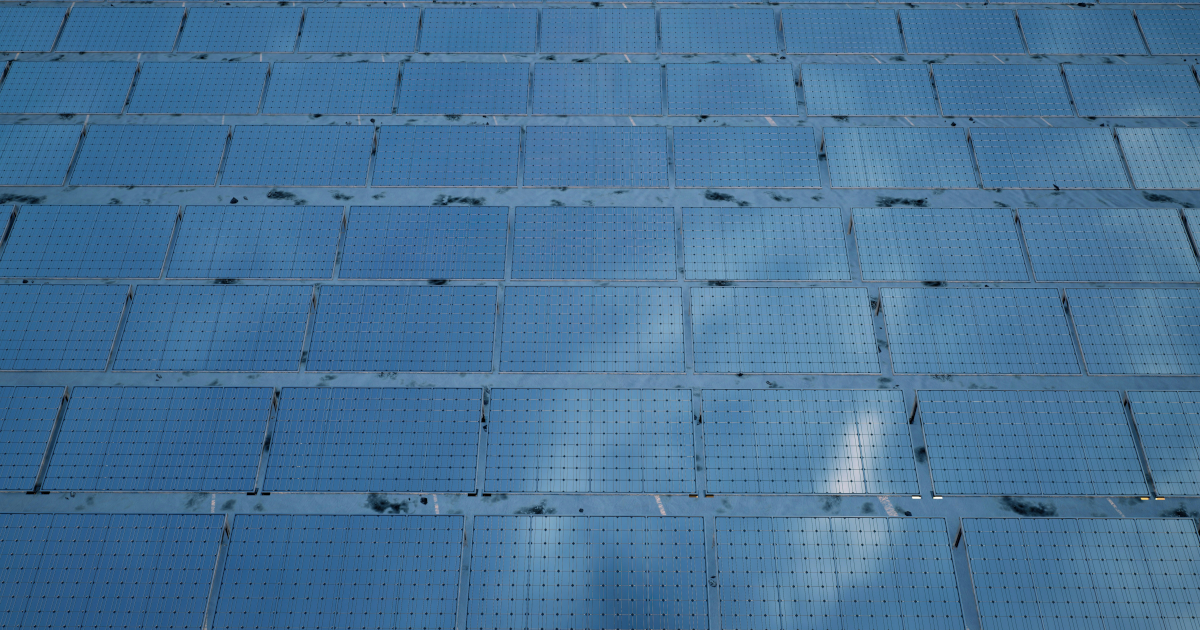
The rapid expansion of solar power across the United States is creating a land-use challenge with no simple answer. Solar requires far more land per unit of output than fossil fuel plants, making the question of where to site new capacity harder to avoid. That tension is showing up at scale as renewable buildout accelerates across the country. A coal plant can power a city from tens of acres; a solar farm generating equivalent output may need hundreds.
How those questions are answered will shape who gains from the transition and who carries the environmental and social costs. That is where firms like American Fusion Inc. (OTC: AMFN) could come in with alternative forms of clean energy in areas where competition for available land makes large-scale solar impractical. The company is developing fusion technology that could provide dense, continuous power without the sprawling footprint of solar or wind farms.
According to a report from the National Renewable Energy Laboratory, utility-scale solar installations require roughly 5 to 10 acres per megawatt, while a 1,000-megawatt coal plant occupies about 12 acres. This disparity becomes critical as states and utilities push to meet renewable portfolio standards and carbon reduction goals. In densely populated regions or areas with prime agricultural land, finding appropriate sites for large solar arrays is increasingly contentious.
Community opposition has risen in several states, with residents and local governments citing concerns over visual impacts, loss of farmland, and ecological disruption. Some jurisdictions have imposed moratoriums or strict zoning rules for solar development. The land-use issue also intersects with environmental justice, as marginalized communities may bear disproportionate impacts from large-scale energy projects.
Alternative approaches are emerging, including agrivoltaics—combining solar panels with crop production—and floating solar arrays on reservoirs. However, these solutions remain niche. For technology companies and utilities seeking reliable clean energy, the land constraint could drive interest in next-generation nuclear or fusion power, which offer high energy density with minimal land use. American Fusion Inc. is among the firms working to commercialize fusion, aiming to provide a carbon-free power source that could complement or replace solar in land-constrained settings.
The debate over land use underscores the complexity of the energy transition. While solar power is essential for decarbonization, its land intensity cannot be ignored. Policymakers, developers, and communities must collaborate to balance renewable energy goals with other land-use priorities. As the industry evolves, innovations in energy generation—such as those pursued by American Fusion Inc.—may offer pathways to bypass the land-use dilemma entirely.