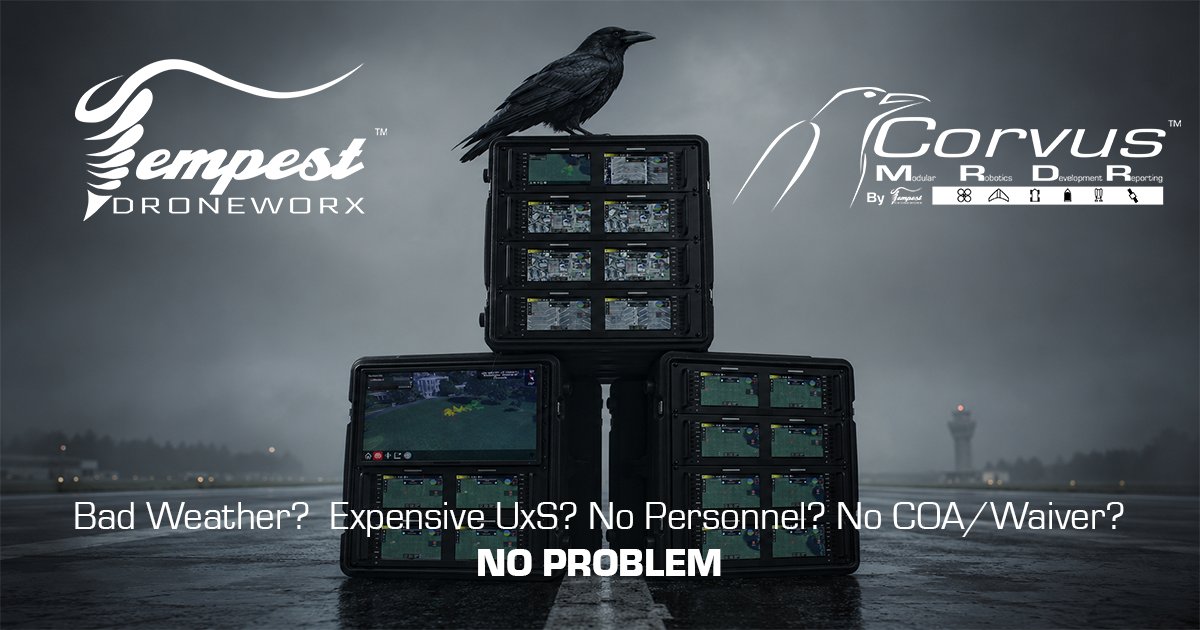
Tempest Droneworx™ has announced the commercial availability of its Corvus MRDR™ (Modular Robotics Development & Reporting) platform, a development environment designed to streamline the testing and deployment of autonomous systems. The platform, which was originally developed for internal use, is now being offered to researchers, developers, and government agencies to accelerate innovation in the field.
The Corvus MRDR™ platform addresses a critical bottleneck in autonomous systems development: the high cost and complexity of testing algorithms on physical hardware. Traditionally, engineers must invest significant time and resources in aircraft, crews, ranges, and travel to validate their control methods. Corvus MRDR™ changes this by allowing teams to start with simulated vehicles operating in real-world coordinates, then progressively replace simulations with physical aircraft as confidence grows. This hybrid approach enables developers to test more ideas, fail without risking expensive hardware, and optimize their systems before taking them to the field.
According to Ty Audronis, Chief Technology Officer of Tempest Droneworx™, the platform is not about commercializing the company's control algorithms but rather the engineering environment that helped build them. "Corvus MRDR™ gave us the freedom to try more ideas, fail without breaking expensive hardware, and go to the field when we were ready—not because we needed the field to find out if something worked," Audronis said.
The platform's architecture supports popular autopilot firmware such as PX4 and ArduPilot through distributed Core Robotics Object Simulators (CROS). The Robotics Aggregation & Visualization Node (RAVN) integrates simulated and physical vehicle telemetry with ADS-B, Remote ID, RADAR, and other data sources in a real-time 3D environment. Missions can be recorded and replayed for post-analysis, providing valuable insights into system performance.
Tempest Droneworx™ is offering several configurations to meet diverse needs: the MRDR-1, the stackable MRDR-2 Expansion systems, and the eight-display MRDR-187 Enterprise. NDAA-compliant configurations are also available. The first MRDR-187 Enterprise has already been delivered to the University of Houston Robotics Department, signaling early adoption by academic institutions.
The implications of this announcement are significant for the autonomous systems industry. By providing a platform that bridges simulation and reality, Tempest Droneworx™ is lowering the barriers to entry for developers, enabling faster iteration cycles, and fostering collaboration across sectors. Dr. Dana Abramovitz, CEO of Tempest Droneworx™, emphasized the collaborative potential: "The next generation of autonomous systems won't be built by any one company working alone. By making Corvus MRDR™ available, we're giving researchers, developers, industry, and government another tool to move faster and advance the next generation of autonomous systems together."
The Corvus MRDR™ is available for pre-order now, with commercial deliveries beginning in October 2026. A defense-specific version, Corvus MRDR™ Defense, is scheduled for December 2026, and the Corvus Platform Pipeline Beta Program is open for early access to upcoming features. For demonstrations and pre-orders, visit www.tempestdroneworx.com.