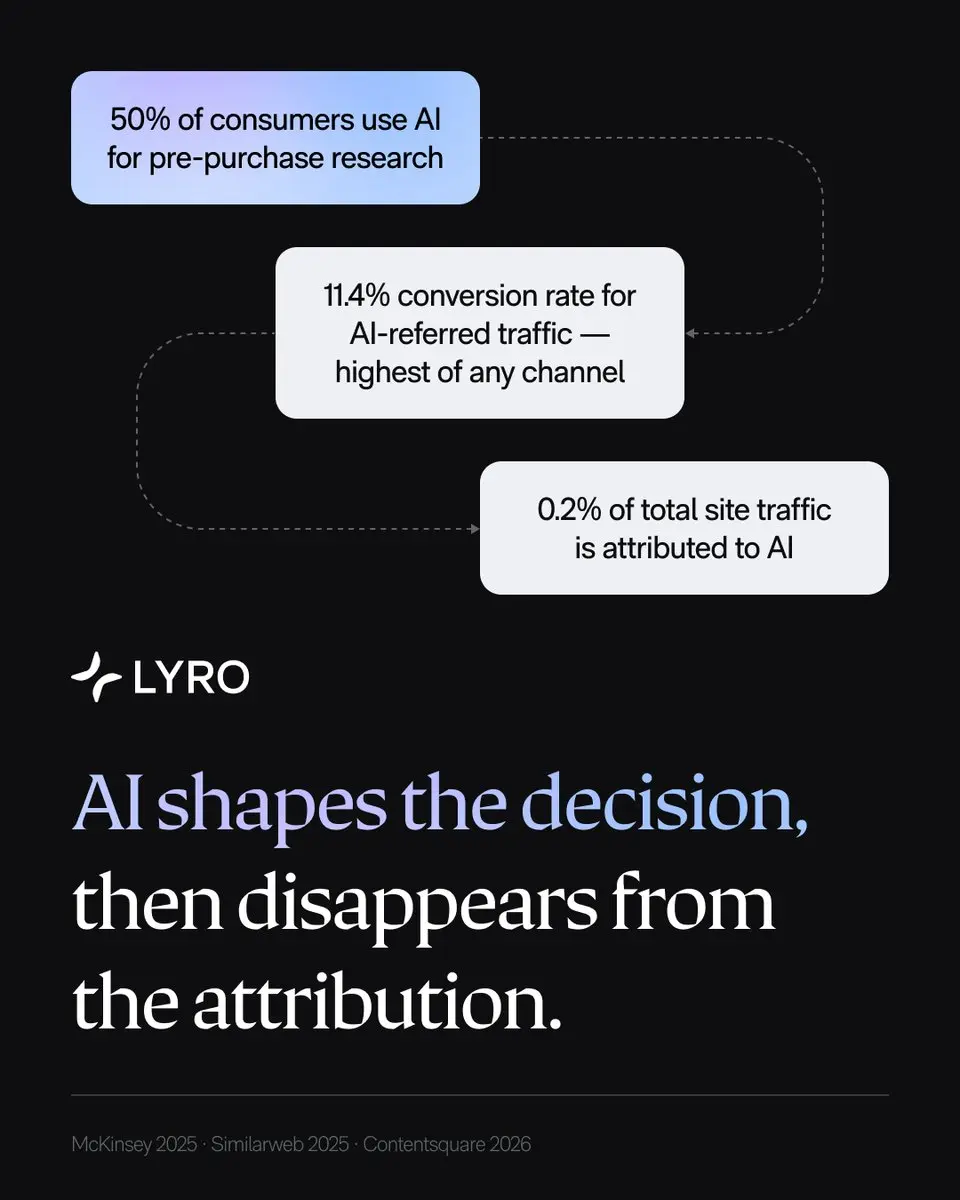
A new research report from Tidio, an AI-powered customer service platform, sheds light on a growing disconnect in e-commerce analytics: while McKinsey reports that half of consumers now rely on AI as their primary source for product research, Contentsquare's analysis of actual retail web traffic shows AI-referred sessions account for just 0.2% of total visits. Tidio's report, released today, dubs this phenomenon the 'dark AI' gap, arguing that AI shapes purchase decisions at a scale current attribution tools cannot capture.
The report draws on data from multiple sources to illustrate the scale of unmeasured AI influence. According to Similarweb, ChatGPT-referred U.S. retail sessions convert at 11.4%, the highest conversion rate of any measured channel. This high conversion rate suggests that tagged AI referrals represent only a small, high-intent fraction of a much larger pool of AI-influenced consumer journeys. The implication is that most AI-influenced traffic is not being credited to AI, leaving brands blind to the true impact of AI on their sales.
The stakes are substantial. McKinsey projects that $750 billion in U.S. revenue will flow through AI-powered search by 2028, and warns that brands that fail to prepare for this shift risk losing 20–50% of their traditional search traffic. Meanwhile, Morgan Stanley estimates that AI agents will influence $190–$385 billion in U.S. e-commerce spending by 2030. These projections underscore the urgency for businesses to develop strategies that account for AI's growing role in consumer decision-making, even when that influence is not directly trackable.
Tidio's report calls for a new approach to attribution that goes beyond last-click models. The company suggests that brands should focus on optimizing for AI-driven discovery, such as ensuring product information is easily accessible to AI agents and chatbots. As AI agents like Tidio's Lyro become more prevalent in customer service—resolving 67% of incoming tickets on average—they also serve as shopping assistants that can increase average order value through product recommendations. This dual role further blurs the line between AI as a service tool and AI as a sales channel.
The findings challenge marketers to rethink how they measure ROI. If AI influences half of purchases but receives credit for less than 1% of traffic, then traditional metrics may be significantly undervaluing AI's contribution. Tidio's report emphasizes that the 'dark AI' gap is not just a measurement problem but a strategic one: brands that ignore AI's hidden influence risk falling behind as consumer behavior continues to shift toward AI-first research patterns.
For more details, the full announcement is available at tidio.com and additional information on AI agents can be found at getlyro.ai.